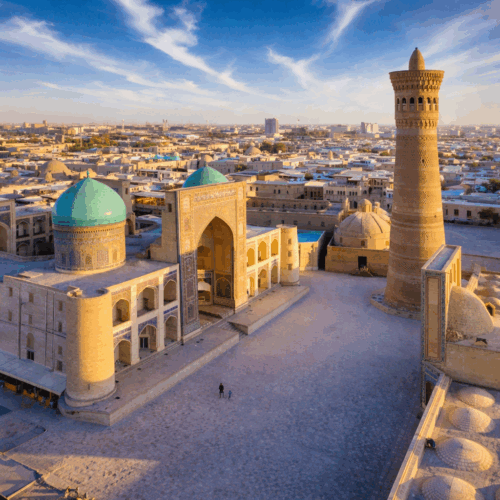
India and Uzbekistan: A New Rapprochement in the Heart of Asia

Steppe Ahead Column
Author: Thorsten Gutmann
In May 2025, Uzbekistan issued a clear appeal to India: It was time to revitalize its long-neglected Central Asian policy. At the Termez Dialogue—a new multilateral forum with over 200 participants—Tashkent called for visible Indian engagement. While China is making headway with infrastructure development and Russia is maintaining its historical influence, India’s role has so far remained limited.
But things are starting to move.
Building Trust on a Legal Foundation
As early as the fall of 2024, India and Uzbekistan laid an important foundation: With the Bilateral Investment Treaty (BIT), signed on September 27 in Tashkent, both countries have secured mutual investment guarantees. The agreement protects against expropriation, guarantees transparent procedures, and allows for dispute resolution through international arbitration tribunals. It is seen as a confidence-building measure—not only between the governments but also toward the private sector.
Trade Data Shows New Momentum
The relationship is also intensifying economically. According to UN COMTRADE data, India’s exports to Uzbekistan rose to over $477 million in 2024—a record high. Pharmaceutical products, vehicles, meat products, machinery, and foodstuffs are in particularly high demand. The total investment by Indian companies in Uzbekistan exceeds 60 million U.S. dollars, primarily in IT, education, logistics, and the healthcare sector.
Culture as a Strategic Link
India enjoys a cultural presence in Uzbekistan that extends far beyond economic interests. Bollywood films, yoga, classical music, and Ayurveda are an integral part of public life. The Lal Bahadur Shastri Centre for Indian Culture in Tashkent reaches thousands of people annually. Hindi is taught in schools. Here, culture becomes a geopolitical resource.
Shared Interests – and Security Issues
In multilateral forums such as the Shanghai Cooperation Organization (SCO), BRICS, or the India-Central Asia Dialogue, both countries work closely together. In terms of security policy as well, initiatives such as the “DUSTLIK” military exercise demonstrate a growing willingness to cooperate—particularly with regard to Afghanistan and regional stability.
Conclusion: Uzbekistan as a market of the future—if India so desires
India is beginning to position itself more clearly in Central Asia—not through grand gestures, but through concrete measures. With a legally stable framework, growing trade, and cultural soft power, the conditions for a partnership on equal footing are emerging.
Uzbekistan offers more than just favorable conditions. The country is strategically located, ready for reform, and open to cooperation. For India, this presents an opportunity to gain a long-term economic and geopolitical foothold—in a region that is increasingly becoming a battleground for global influence.
Whether Delhi seizes this opportunity depends not on symbolic gestures, but on its willingness to view Central Asia as a genuine market of the future and a foreign policy arena with intrinsic value.
Sources:
- The Diplomat (June 2025): “Uzbekistan’s Connectivity Outreach”
- Hindustan Times (September 2024): “India and Uzbekistan sign Bilateral Investment Treaty”
- UN COMTRADE 2024 / TradingEconomics
- Indian Ministry of External Affairs: “Uzbekistan – Bilateral Brief 2024”