Steppe Ahead: The Allure of Central Asia
Author: Thorsten Gutmann
When I was studying in Berlin, I wanted to improve my Russian—so I looked for a language exchange partner. I had several over the years, but one young woman from Kazakhstan has stayed with me in particular. She told me about a world I didn’t know: About beshbarmak, the national dish made of horse meat that you eat with your fingers. About wedding rituals in which, in the past, the bride was “kidnapped” on a horse—not really, but symbolically, as a traditional game. It sounded archaic, proud, fascinating.
Back then, I didn’t know that my life would one day be so closely tied to Central Asia.
Later, I worked in Russia for many years—and met my wife there: a Russian woman, born in Almaty, raised in Astana. Two cities with completely different characters: Almaty is green, steeped in history, and framed by mountains. Astana, on the other hand, is laid out in straight lines, boldly built, a futuristic vision in the middle of the steppe.
And yet it wasn’t until 2022 that I traveled to Kazakhstan for the first time myself. I remember the drive from the airport to the center of Astana well—wide boulevards, monumental buildings, interspersed with glass towers topped by golden domes, prefabricated buildings from the Soviet era, and in between, futuristic architecture, as if from another era.
This coexistence of past and future—it defines this country.
Kazakhstan today: rich in natural resources, strategically important, underestimated
Even before that, Kazakhstan had caught my attention as an investor: index funds, commodity stocks, strong returns. The country is rich in natural resources: oil, natural gas, uranium, chromium, copper, zinc, manganese, bauxite, and rare earth elements. It is one of the world’s most important uranium suppliers—France’s nuclear industry depends on it.
But Kazakhstan is more than just a supplier of raw materials. It is nestled between Russia and China, is part of the New Silk Road, a member of the Eurasian Economic Union—and at the same time is actively seeking closer ties with Europe and the U.S.
In my next column, I will show which countries are actually among the largest investors in Kazakhstan—and why this is particularly interesting from a German perspective.
German Companies: Lots of Potential, Little Strategy
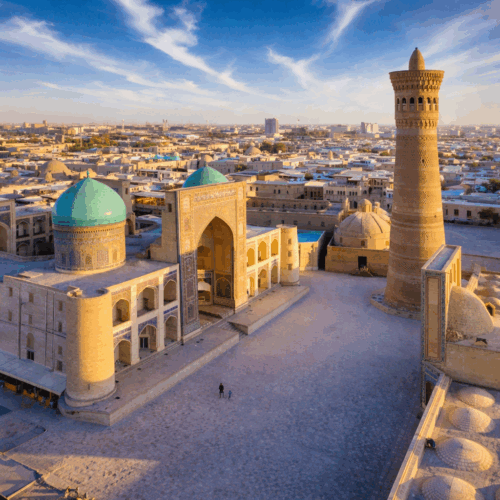
For Central Asia as a whole has fascinated me ever since—not just Kazakhstan, but also Uzbekistan, Kyrgyzstan, Tajikistan, and Turkmenistan. Uzbekistan, for example, impresses with its ancient cities—Samarkand, Bukhara—with its culture, colors, and history. I hope to be able to travel to these countries myself soon.
And that is exactly why I am launching my new column, Steppe Ahead, here on Ostwirtschaft.de today.
It will appear regularly starting now—with a personal perspective, strategic interest, and journalistic curiosity. It’s about the economy, investments, and geopolitical developments—in short: the opportunities and challenges in a region that is becoming increasingly important.
Yes, German companies are active in Central Asia—in mechanical engineering, environmental technology, the chemical industry, energy management, logistics, and the export of dual vocational training. But there is a lack of strategic depth. While other countries—such as the U.S., France, or the Netherlands—are making targeted investments, Germany often appears hesitant. Yet now, more than ever, is the time to forge new partnerships. For many companies, Russia is no longer a viable market. Central Asia can and should be one of the alternatives.
For the potential is enormous:
- cooperation on securing raw materials,
- energy projects in the fields of renewables and hydrogen,
- digital infrastructure development,
- educational cooperation and skilled worker programs.
Many German companies are already discovering this potential—in very practical ways. Europa-Park in Rust, just around the corner from me, specifically hires employees from Kazakhstan and Uzbekistan. Why? Because they are well-trained, resilient, reliable—and motivated to break new ground.