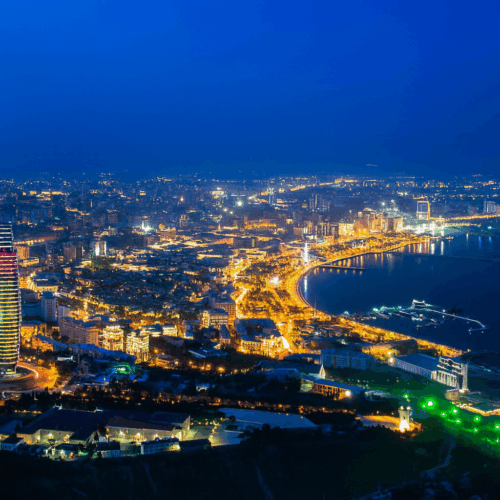
“Azerbaijan is a strategically underestimated partner of Europe!”

Exclusive interview with Urs Unkauf, Chairman of the German-Azerbaijani Forum (DAF). The interview is conducted by OW writer Jonas Prien.
Mr. Unkauf, since the summer of 2025, you have been representing the interests of the DAF as its Chairman. What connects Germany to this small country on the Caspian Sea?
Viewed objectively, Azerbaijan is anything but a “small” country—at least not from a geostrategic perspective. It lies at a geographical crossroads that is of central importance, both historically and today: between Russia to the north, Iran to the south, Turkey, the Middle East, and Central Asia. From a European perspective, this location makes Azerbaijan an indispensable partner for issues related to energy supply, transport corridors, and economic diversification. German-Azerbaijani relations have a tradition dating back to the first half of the 19th century, when Swabian settlers found a new home there. The traces of this German cultural heritage are today honorably remembered and preserved in Azerbaijan.
What do relations look like today?
For Germany, Azerbaijan is currently of growing relevance, particularly in the context of energy policy. Its role as one of the ten most important crude oil suppliers and as a supplier of natural gas via the Southern Gas Corridor is now well known, but its potential is still often underestimated. At the same time, it is currently becoming clear that Azerbaijan is broadening the foundation of its economy—moving away from a reliance solely on oil and gas toward logistics, industrial production, renewable energy, and digital technologies. Germany is now among Azerbaijan’s ten most important trading partners, reflecting increasingly substantial economic interdependence between the two countries. Furthermore, Azerbaijan serves as a stabilizing political factor in a region that has long been marked by uncertainty. This stability is not only politically relevant but also a prerequisite for economic engagement in the interest of German business. The current peace process with neighboring Armenia is increasingly gaining positive momentum. This long-standing historical conflict resurfaced at the end of the Soviet era. Since the late 1980s, it has tied up numerous resources and capacities that are now being released, thereby simultaneously opening up new scope for international partnerships. Germany should recognize these opportunities—in its own well-understood interest—and identify points of contact for concrete projects and initiatives with Azerbaijan.
How do you assess the partnership at present, and where is there a need for action?
German-Azerbaijani relations are built on a solid foundation, particularly in the economic sphere. There are established formats for exchange, a growing number of business collaborations, and a fundamental interest on both sides in deepening relations. At the same time, it must be noted that the existing potential is far from being fully exploited. I see a need for action primarily in three areas:
There is often a lack of long-term structured platforms that specifically match concrete projects—for example, in the fields of infrastructure, energy, or industry—with potentially suitable partners. Another area requiring attention is the perception of Azerbaijan in Germany. The complex political and economic realities of Azerbaijan are often presented in Germany in an inadequate or oversimplified manner. This makes it difficult to establish a factual basis for debate. Direct exchange between relevant institutional actors could also be significantly more intensive, particularly at the working level and also outside of state political structures. This is where the German-Azerbaijani Forum sees its role: as a civil society platform that bridges precisely these gaps and facilitates concrete cooperation. As a non-profit association, we operate autonomously and independently of official domestic and foreign agencies.
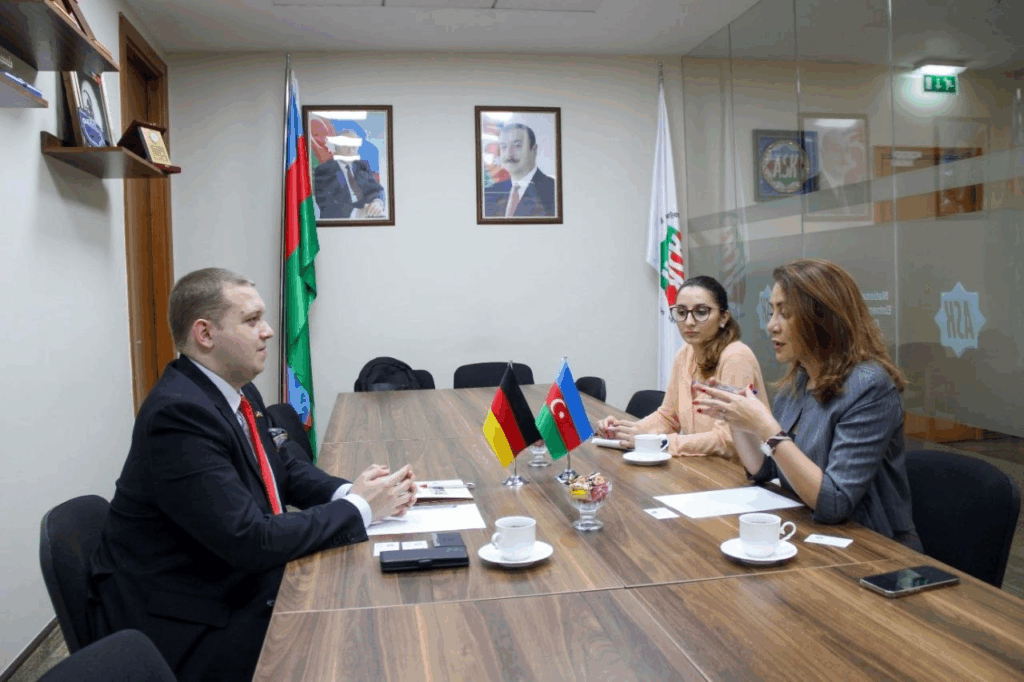
In dialogue with the Confederation of Industrialists and Entrepreneurs of Azerbaijan (ASK)
In your opinion, is Azerbaijan’s image in Germany distorted, or is the criticism justified?
In our view, despite its rich resources, religious tolerance, and hospitality shaped by multicultural traditions—even as part of ancient Persia, the Russian Empire, and later the Soviet Union—Azerbaijan never received the recognition it deserved. It was always on the periphery of the great empires. Its inhabitants did not belong to the majority religion in Russia and the Soviet Union, and the attempt to establish a joint South Caucasus republic after the 1917 Russian Revolution failed. The armed conflict with Armenia led to great instability after 1990. Azerbaijan’s attempts to gain attention and recognition within European structures were certainly not very skillful. Unfortunately, these experiences continue to have an impact today. When it seems expedient, the media are happy to perpetuate the stereotypes and narratives formed back then. In Germany, too, there remains a serious imbalance between the perception of Azerbaijan and the actual developments taking place there. There is often a lack of reporting based on firsthand observation and in-depth knowledge of the country, its social structure, and its economic transformation. Over the past decade, Azerbaijan has undergone a significant wave of modernization; socio-cultural change is evident in many places, not just in the capital, Baku. The country has now become an anchor of stability in a turbulent region.
This makes it all the more important to focus more on a comprehensive and balanced perspective. Azerbaijan is undergoing a profound transformation—economically, infrastructurally, and socially—while simultaneously assuming responsibility for stability and connectivity in the South Caucasus and the Caspian region. From the perspective of the German-Azerbaijani Forum, it is therefore crucial to ground the dialogue in an objective, fact-based foundation and to promote direct exchange. A nuanced perspective creates the conditions for trust and, consequently, for resilient cooperation.
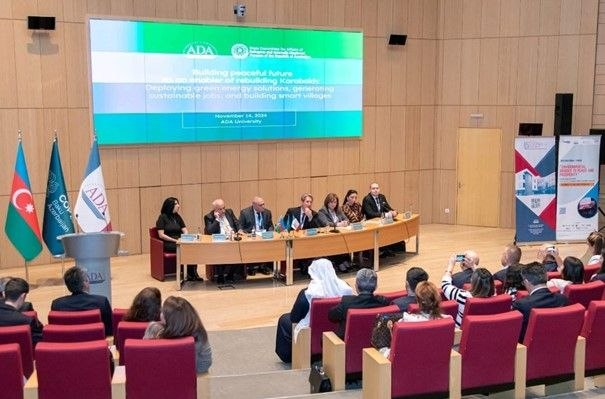
In the context of the COP 29 World Climate Conference, which took place in Baku in 2024, Urs Unkauf, then Federal Executive Director of the BWA, organized a side event at ADA University with high-ranking guests, including former ministers, top diplomats, entrepreneurs, and family offices
How is the current conflict between Iran and the U.S. affecting Azerbaijan?
Azerbaijan is in a geopolitically sensitive position and traditionally pursues a very balanced foreign policy toward regional and global actors. Relations with both Iran and the U.S. are of strategic importance. The current tensions between Tehran and Washington therefore have an indirect impact on the entire region—for example, in the areas of security, energy, and transportation routes. For Azerbaijan, this means above all maintaining its role as a stable and predictable actor. At the same time, this situation also presents opportunities. As a reliable partner to both sides, Azerbaijan can play a stabilizing role and further expand its importance as a hub between different geopolitical regions.
The peace agreement with Armenia has caused a stir internationally. What is needed now to maintain security and peace in the region in the long term?
The peace agreement brokered by U.S. President Donald Trump is undoubtedly a historic step. However, implementation is crucial. Peace does not arise solely from agreements, but through concrete confidence-building measures. These include, in particular, the full normalization of bilateral relations between Azerbaijan and Armenia, the mutual demarcation and recognition of borders, the opening of transport and trade routes, and the establishment of dialogue formats in the economic and civil society sectors. A key point here is the restoration of regional connectivity. Transport routes that have been blocked for decades must be restored. This creates economic incentives for stability throughout the region. Furthermore, continued international support for the peace process is important—though in a role that respects the ownership of the states involved.
The Armenian “Crossroads for Peace” initiative aims to strengthen connectivity and trust in the region. How has Azerbaijan reacted?
Azerbaijan has generally responded positively to initiatives aimed at opening transport routes and fostering economic cooperation. However, Baku places great emphasis on ensuring that such concepts are not considered in isolation but are implemented within the framework of existing agreements. In particular, this concerns the practical implementation of transit links—for example, between the heartland of Azerbaijan and the Nakhchivan exclave, which borders directly on Turkey. This issue is of central importance not only politically but also economically. Azerbaijan’s position on this is clear: connectivity is desirable, but it must be based on reliable, binding, and mutually accepted foundations.
How do you assess the feasibility of the Armenian initiative? Will goods and people soon be able to cross the border by land?
Implementation depends less on technical factors than on political ones. Infrastructure can be established relatively quickly—as numerous examples worldwide demonstrate. The key factor here is trust between the parties involved. There is currently real progress, and the momentum is generally positive. Nevertheless, we should remain realistic. Establishing functioning transit corridors requires clear regulations, mutual security guarantees, and appropriate administrative structures.
In the short term, initial openings are conceivable, particularly for freight transport. However, a full return to normalcy, including the free movement of people, will be a gradual process. In the long term, the potential is enormous: the South Caucasus could develop into the most important transport corridor between Europe and Asia. The prerequisite for this is that the political agreements are consistently implemented.