Key interest rate cut to 15%; 1% growth target to remain unchanged
Author: Klaus Dormann
On Friday, the Russian Central Bank cut its key interest rate again by 0.5 percentage points to 15.0 percent. It was the second cut this year and the seventh since June 2025. At that time, the Central Bank began lowering the key interest rate from a long-standing high of 21 percent. The high interest rates were intended to curb inflation, which had been driven up by sharply rising defense spending. Now, lower interest rates are intended to stabilize the Russian economy, whose growth fell from 4.9 percent to 1 percent in 2025.
Russian Central Bank
Key Interest Rate in Percent/Year
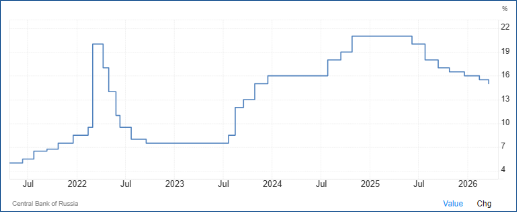
Trading Economics, Russia Interest Rate, March 20, 2026
Central Bank Expects “Balanced Growth”
Explaining the latest key rate cut, Central Bank Governor Elvira Nabiullina said in her statement on Friday’s rate decision:
“The economy is approaching a balanced growth path. This has enabled us to further ease our monetary policy stance.”
Nabiullina apparently considers “balanced growth” to have been achieved if the Russian economy grows by 0.5 to 1.5 percent this year, as expected in the Central Bank’s “medium-term forecast.” Although Russia’s gross domestic product is unlikely to reach the annual growth rate of 1.6 percent previously projected by the Central Bank in the first quarter of 2026, she maintained during the press conference that the Russian economy could grow by around 1 percent again in 2026.
The Institute for Economic Forecasting of the Russian Academy of Sciences (IEF-RAS) also expects, in its recently updated quarterly forecast on economic developments in Russia, that gross domestic product will rise by another 1 percent in 2026 as a whole. However, it assumes that real gross domestic product is likely to remain virtually stagnant in the first half of the year.
Artem Chugunov commented on this in a Kommersant op-ed:
“At its core, the current discussion revolves around reviewing the Central Bank’s thesis on the ‘normalization’ of economic dynamics in Russia, which it outlined in the latest edition of its report ‘What the trends say.’ The regulator describes the current situation as a transition from the overheated growth of 2023–2024 to a more sustainable development path—with declining demand, reduced inflationary pressure, and a more balanced economic structure. Following this logic, the Central Bank interprets the current economic slowdown as a necessary phase in the transition to a new equilibrium.”
Nabiullina: How the war in the Middle East could impact the economy
Regarding the consequences of the war in the Middle East for Russia and the global economy, Nabiullina stated the following during the press conference following the key interest rate decision, according to a Finam report by Olga Belenkaya:
“The situation in the Middle East is having a significant impact on global commodity markets. The ultimate impact on the Russian economy will depend on the duration and scale of these geopolitical events.”
On the one hand, higher oil prices could support Russia’s export revenues and the ruble in the short term, Nabiullina noted. However, she also warned:
“However, when we talk about longer-term effects, the situation in the Middle East could negatively impact growth prospects for global demand and investment, which could lead to higher inflation in energy-importing countries and disruptions in supply chains. Essentially, this is another supply shock that will affect global costs and, to some extent, also impact prices on the Russian market. Furthermore, logistical problems could also affect our export volumes.”
Russia’s inflation rate has nearly halved since spring 2025
By March 2025, the year-over-year annual increase in consumer prices had accelerated further to 10.3 percent. Since then, however, it has nearly halved. In February 2026, the annual inflation rate stood at 5.9 percent.
Year-over-year increase in consumer prices
in percent
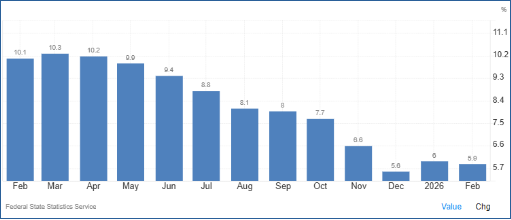
Trading Economics, Russia Inflation Rate, March 20, 2026
The Central Bank expects the rise in consumer prices to decline further over the course of 2026, reaching 4.5 to 5.5% in December. The target “inflation target” of 4% is expected to be achieved by the end of 2027.
Nabiullina: Price growth fell again in February
In her statement on the key interest rate decision, Central Bank President Nabiullina first noted that the rise in consumer prices had slowed again in February 2026. The January increase in the value-added tax, as well as in excise taxes and fees, was apparently passed on to prices mainly in the first weeks of 2026.
According to Nabiullina, inflation expectations among households and businesses rose only in the short term. In February and March, they fell back to the average level of 2025. However, they remained worryingly high.
In mid-March, the annual inflation rate stood at 5.9 percent
The Central Bank’s press release on the key interest rate decision cites the following data on current price trends, among other things:
In the January-February period, the seasonally adjusted price increase, extrapolated to an annual rate, averaged 10.2%, following 4.4% in the fourth quarter of 2025. In February, the inflation rate slowed significantly after the effects of one-off factors from the beginning of the year had subsided.
As of March 16, the annual inflation rate stood at 5.9%.
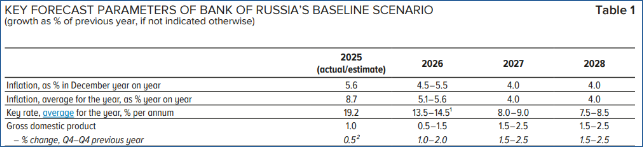
According to the central bank’s medium-term forecast, the annual inflation rate will fall to 4.5 to 5.5% by December 2026 if current monetary policy is maintained (see table below).
Starting in 2027, annual inflation is expected to be within the target range of 4.0 percent.
Medium-term forecasts of the Russian Central Bank (excerpt)
Trends in inflation, the key interest rate, and economic growth from 2025 to 2028
Bank of Russia: Commentary on the Bank of Russia’s Medium-Term Forecast, February 26, 2026
Nabiullina: Domestic demand is cooling, particularly private consumption
According to the Central Bank Governor, high-frequency data from the beginning of the year point to a cooling of domestic demand, particularly consumer spending. This was partly due to many consumers bringing forward expensive purchases to 2025 in anticipation of increases in the value-added tax and the car recycling fee. Additionally, surveys conducted at the start of the year showed that small businesses reported significantly lower demand expectations.
Surveys also showed that the shortage of skilled workers is gradually easing as companies plan fewer hires. Unemployment, however, remains at a record low.
The rise in capital investment will be “more moderate” in 2026
According to the central bank’s estimates, Nabiullina said, the economy’s production capacity continued to expand last year. While investment in fixed assets declined slightly by the end of 2025, it remained close to the record levels of recent years. In 2025, it was nearly a quarter higher in real terms than in 2021.
Investment activity remained high, particularly in the manufacturing and service sectors. This was attributable, among other things, to government support measures and investments aimed at substituting imports.
According to the central bank president, investment plans for 2026 are more moderate. Business surveys showed that more companies plan to expand their production capacity in 2026 than to reduce it.
In the first quarter of 2026, the annual GDP growth was likely lower than expected
In its commentary dated February 26 on its latest “medium-term forecast,” the Central Bank projected that real gross domestic product in the first quarter of 2026 would likely be 1.6 percent higher than a year ago. However, during the press conference on March 20, Central Bank President Nabiullina noted that, according to the latest economic data from Rosstat, growth in the first quarter is likely to fall short of this forecast. At the same time, however, she stated, according to Finmarket.ru: “It is still too early to speak of the sustainability of the trend (of slowing economic activity). We expect that by the time of the meeting to decide on the key interest rate in April, further information will be available, including a quarterly breakdown of the data (on GDP growth) for the past year. This is crucial for drawing conclusions about emerging economic trends.”
As reasons for the weak production performance at the start of 2026, she again cited, among other things, the “base effect”: The economy had grown strongly in the comparable month of January 2025. In addition, there were two fewer working days in January of the current year than in the previous year. Furthermore, the exceptionally cold weather this year had slowed down production in the construction sector. Regarding private consumption, there had been a counter-movement at the start of the year following the strong increase at the end of last year.
The deputy chairman of the central bank, Alexey Zabotkin, also stated that economic growth in the first quarter of 2026 was likely to be slightly lower than the central bank had previously expected. However, overall economic output growth remains within the forecast range of +0.5 to +1.5 percent that the Central Bank had cited in its medium-term forecast published in February (see table above).
Regarding price trends, Zabotkin noted: The inflation rate, which was likely also slightly lower in the first quarter than the Central Bank had expected, will remain within the range of 4.5 to 5.5 percent specified in the Central Bank’s medium-term forecast for 2026. He was likely referring to the annual price increase in December 2026. On an annual average for 2026, the central bank expects consumer prices to rise by 5.1 to 5.6 percent (see table above).
Central Bank Bulletin: Inflation and Growth Are “Normalizing”
In the Central Bank Bulletin “What Do the Trends Say?”, which is published regularly shortly before key interest rate decisions, the Central Bank’s Research and Forecasting Department had already pointed to a “normalization” of the rise in consumer prices and economic growth rates. The Russian economy is expected to return to a “balanced growth path” by the end of 2025 following the “unsustainably high momentum.” A Central Bank press release summarizes this as follows:
The rise in consumer prices slowed in February, as expected, following a sharp increase in January. It approached a level corresponding to an inflation rate of 4% on a seasonally adjusted and annualized basis.
The pass-through of the increase in value-added tax and other taxes and fees implemented in early 2026 to prices is largely complete. Inflation expectations among households and businesses have declined from the peak reached at the end of 2025.
According to preliminary data and surveys, economic growth slowed at the start of the year compared to the strong performance in December 2025.
The labor market is slowly normalizing. Wage growth is gradually aligning with productivity growth. The central bank thus sees the foundation for a further increase in consumption and overall economic activity.
Significant fluctuations in production at the turn of the year
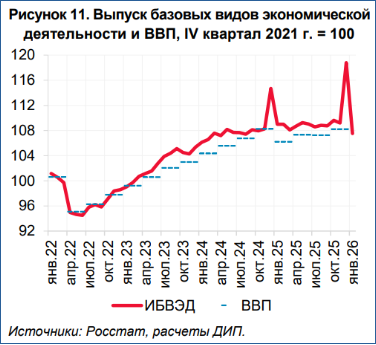
The following figure from the Central Bank’s bulletin shows how sharply the production index in the “core sectors” of the Russian economy fluctuated at the turn of the year 2025/2026. A strong surge in growth in December was followed by an even sharper slump in production in January (red line).
In the following figure, the Central Bank compares production trends in the “core sectors” of the economy with the trend of the seasonally and calendar-adjusted index value of total real gross domestic product (4th quarter 2021 = 100). According to the Central Bank’s estimate, aggregate economic output in the fourth quarter of 2025 is likely to have been higher than in the third quarter. This is shown by the dashed blue line. Rosstat will publish revised quarterly GDP data for 2025 on April 10.
Trends in production in the “core sectors” (red line)
and total gross domestic product of the Russian economy,
Q4 2021 = 100
Russian Central Bank: What the Trends Say, 2/26, March 12, 2026
The Central Bank’s bulletin comments on the sharp fluctuations in production at the turn of the year, noting that the rise in production in the economy’s “core sectors” in December was likely due to “peculiarities of statistical accounting.” For some products that take a particularly long time to complete, production data is not recorded until after the products have been shipped. This was likely the case at the end of 2025 in the “manufacture of base metals and other non-ferrous metals, as well as the production of nuclear fuel” sector. By early 2026, production had returned to the average level seen in the fall of 2025.
Production in the manufacturing sector also fluctuated sharply
According to the Central Bank report, production in the “manufacturing sector” (seasonally adjusted) plummeted in January just as sharply as production across all core sectors of the Russian economy (red line in the figure below). Production in mining, on the other hand, continued to remain virtually stagnant.
Production in mining (gray line)
and manufacturing (red line)
2021 = 100, seasonally adjusted
Russian Central Bank: What the Trends Say, 2/26, March 12, 2026
The Central Bank also notes the following regarding economic developments in January:
Only a few consumer goods sectors recorded a stable upward trend in January. Demand for their products continued to be supported by strong wage growth at the end of 2025. Demand for Russian exports remained “subdued” in light of tightened sanctions.
Together with the results of most business surveys (e.g., S&P Global’s Purchasing Managers’ Indices, the Central Bank’s Business Climate Survey), this points to “a gradual slowdown in economic growth.” According to financial flow data from the Russian Central Bank’s payment system, this trend continued into early 2026.
IEF RAS: GDP will stagnate almost entirely in the first half of 2026
Unlike the Central Bank, which expects only a slowdown in the growth of the Russian economy, the new quarterly forecast from the “Institute for Economic Forecasts” (IEF) of the “Russian Academy of Sciences” (RAS) anticipates an almost complete standstill in GDP growth in the first half of the year. Nevertheless, according to the institute, Russia’s economic growth could reach a rate of 1.1% in 2026. However, this would only be possible if growth accelerates significantly in the second half of the year. In the first half of the year, aggregate economic output is likely to stagnate. The recovery from the current slowdown will be slow, according to the IEF’s assessment, reports Kommersant.
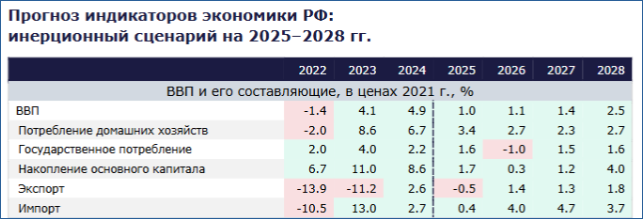
As the following table shows, gross domestic product growth in 2026 will also be driven primarily by private consumption (+2.7%; second row). Government consumption, on the other hand, is expected to be 1.0% lower this year than in 2025 (third row). According to the IEF forecast, growth in fixed investment will continue to slow significantly in 2026, reaching only 0.3%.
Forecast of real gross domestic product and its components through 2028
Year-over-year changes in %
IEF RAS: Quarterly GDP Forecast. Issue No. 69, March 16, 2026; English summary to follow shortly
Critical comments by the IEF on the Central Bank’s restrictive monetary policy
Regarding the economic impact of the Russian Central Bank’s monetary policy, the IEF of the RAS notes that the development of the Russian economy in 2025 was shaped by the “restrictive” monetary policy in place since at least October 2024.
The key interest rate cuts that began in June 2025 were accompanied by an almost equally sharp slowdown in inflation. Although the nominal key interest rate had been lowered to 15.5 percent by February 2026, the real key interest rate—after adjusting for inflation—remained just under 10 percent. This level continues to have a dampening effect on demand and, more importantly, on supply as well.
The expected acceleration in growth will be “very difficult”
The IEF does anticipate accelerated growth rates in the second half of 2026. However, in its assessment, these are likely achievable only through a continuous stimulation of demand for domestic products, higher utilization of production capacity, and a subsequent “stimulation” of the investment cycle. However, achieving this chain of measures will be “very difficult” given the increasing financial constraints in the national budget.
The institute considers it advisable to set new priorities in government spending policy, apart from spending on “national security.” This would entail reducing ineffective spending or expenditures that lack an immediate stimulatory effect in favor of spending items capable of boosting economic growth in the short term—primarily by supporting final demand for domestic products.
The IEF believes it is possible to achieve annual GDP growth of 1.5 to 2% in the second half of 2026 through the realization of previously “deferred” consumer and investment demand, as well as through the restocking of inventories.
However, as in previous years, the main risk is a “negative trend in external economic indicators.”
Recommended reading:
- German-Russian Chamber of Foreign Trade:
Analyses, German; also Russian; (selection):
Hormuz Shock: Europe Facing a New Gas Crisis, 03/18/26
Hormuz Shock: How Big Will Russia’s Unexpected Oil Windfall Be? March 11, 2026
Economic Consequences of the Iran War: Oil Prices, Russia, Tourism; March 2, 2026 - Podcast “Tsars, Data, Facts” by the German-Russian Chamber of Foreign Trade, hosted by Thomas Baier:
Russia’s Economy: Sanctions and Growth Prospects; Guest: Prof. Jacques Sapir, 44 min., 03/09/26
Low gas storage levels: Europe’s challenge in the energy market; Guest: Dr. Heiko Lohmann, “energate Gasmarkt”; 34 min., 03/01/26 - “Die Presse” podcast on the Russian economy: Russia – Gas, Sanctions, Oligarchs:
Is Russia the big winner of the Iran war and China the loser? Recorded on 03/10/26;
The war in Ukraine has made Russia the economic loser and China the beneficiary. The war in Iran, however, has entirely different implications. Vladimir Putin is already laughing up his sleeve. And China? Professor of Sinology Dr. Susanne Weigelin-Schwiedrzik and Russia economist Vasily Astrov (WIIW) in conversation with Eduard Steiner; March 11, 2026
Monetary policy, key interest rate decision on 03/20/26
- Olga Belenkaya, FG Finam: The Russian Central Bank continues to ease its monetary policy, March 20, 2026
- Kommersant, Erdni Kagaltynov: Nabiullina on inflation, the economic impact of the war in Iran, and labor shortages, March 20, 2026
- International Investment: The Russian Central Bank has cut the key interest rate to 15% for the seventh consecutive time, March 20, 2026
- Finmarket.ru: The situation in the Middle East could also affect the Russian market, says Nabiullina, March 20, 2026
- Finmarket.ru: The forecast for Russian GDP growth in 2026 of 0.5–1.5% remains unchanged, March 20, 2026
- Russian Central Bank: The Central Bank of Russia has decided to lower the key rate by 50 basis points to 15.00% per annum, March 20, 2026
- Russian Central Bank: Statement by Elvira Nabiullina, Governor of the Central Bank of Russia, following the Board of Directors meeting on March 20, 2026, March 20, 2026
- Finmarket.ru: Inflation in Russia stood at 0.73% in February, with an annual rate of 5.9%, March 13, 2026
Overall economic development:
- European Leadership Network; Sinikka Parviainen; Senior Economist, Bank of Finland Institute for Emerging Economies: Understanding Russia’s wartime economy and why it matters for Euro-Atlantic security, March 20, 2026
- International Investments: Russia’s Economy in 2025–2026: Slowing Growth and Industrial Decline; EDB Forecasts and Government Positions; March 19, 2026
- Deutsche Welle.com/ru; Oleg Loginov: SIPRI: Russia has passed the peak of military spending growth, March 19, 2026
- IEF RAS: Quarterly GDP Forecast. Issue No. 69, 03/16/26; English summary coming soon; Nezavisimaya Gazeta; Mikhail Sergeev: Russians do not believe in a peace agreement for Ukraine. According to survey participants, the economy still faces its most difficult times ahead, 03/17/26
- Kommersant; Artem Chugunov: The economy is not meeting forecasts. Analysts’ short-term assessments differ from the Russian Central Bank’s expectations, March 17, 2026
- RBC.ru: The Eurasian Development Bank reported a slowdown in the Russian economy, 03/17/26
- Eurasian Development Bank, EDB: Macroeconomic Overview, 03/17/26
- Peace Research Institute Oslo, PRIO; Pavel K. Baev: Moscow calculates benefits of Gulf conflict, coming short, March 17, 2026
- Marxist.com; Alexandra Sablina: How the global crisis is strengthening Russia, 03/16/26
- infosperber.ch: Money almost exclusively for war, debt interest, and pensions. The war prevents Russia from investing in the future of its economy. The future looks bleak, March 16, 2026
- Nezavisimaya Gazeta; Anastasia Bashkatova: For the Russian budget, 100 rubles per dollar is no panacea. A devaluation of the national currency without comprehensive import substitution carries the risk of economic collapse, March 15, 2026
- Russian Central Bank: What the Trends Say, 2/26, Executive Summary in English; 03/12/26
- Interfax.ru: The Russian Central Bank pointed to an expected slowdown in economic activity at the start of the year. Among the reasons cited were tax changes requiring adjustments by businesses and the public, holidays, and the weather. 03/12/26
- RE:RUSSIA: The Vicious Cycle of Military Post-Keynesianism: Why Rapid Income Growth Did Not Boost Domestic Production; 03/11/26
- Deutsche Welle com/ru; Oleg Loginov: Instead of Acceleration: What Is Happening to the Russian Economy? 02/27/26
- Carnegie Politika; Alexandra Prokopenko, Carnegie Berlin Center for Russian and Eurasian Studies: Altitude Sickness: What threat does the continuation of the war pose to the Russian economy? 03/10/26; The original English text was published on 02/16/2026 in “The Economist.”
The Iran War, Energy Supply, and Russia
- Focus.de; Analysis by Ulrich Reitz: Putin Deal? Overshadowed by the Iran War, an explosive idea is circulating, 03/22/26
- FR.de; Marcus Giebel: Hundreds of billions of dollars: How Putin could profit from the Middle East war – three scenarios. Study by the “Kyiv School of Economics” (KSE); 03/21/26
- Kyiv School of Economics: Iran war helps Russia; a long conflict would fundamentally undermine the economic pressure campaign; easing sanctions does not resolve energy market challenges — KSE Institute, Study: Assessment of the Impact of the Iran War on Russia, March 20, 2026
- BBC; Dharshini David, Deputy Economics Editor: Russia, China, and the US – the global winners and losers of the Iran war, March 19, 2026
- Focus de; Lars-Eric Nievelstein: Putin reaches for Ukraine’s treasure: These are the hurdles he faces, March 16, 2026
- BBC Newscast with Steve Rosenberg in Moscow: Will Putin benefit from the Iran war? Steve Rosenberg on the US decision to ease sanctions on Russian oil, March 15, 2026
- Janis Kluge, German Institute for International and Security Affairs (SWP), in a Tagesschau.de interview by Carl-Georg Salzwedel: Easing of oil sanctions. “Russia is the big beneficiary,” text with video, March 13, 2026
- Tagesschau.de analysis by Björn Blaschke: Iran War. Putin the Beneficiary? March 13, 2026
Oil prices and the national budget
- Deutsche Welle.com/ru; Oleg Loginov: SIPRI: Russia has passed the peak of military spending growth, March 19, 2026
- The Moscow Times; Sergei Shelin: Why High Oil Prices Won’t Fix Russia’s Budget Crisis, March 19, 2026
- Nezavisimaya Gazeta; Anastasia Bashkatova: For the Russian budget, 100 rubles per dollar is no panacea. A devaluation of the national currency without comprehensive import substitution carries the risk of economic collapse, March 15, 2026
- The Moscow Times; Sergey Shelin: Oil prices skyrocketed, but they decided to immediately tighten the oil screws, March 13, 2026
- Yahoo Finance; Artur Kryzhnyi, Financial Times: Russia to gain billions in additional revenue from oil price surge due to war with Iran, March 12, 2026
Monthly and weekly economic reports:
- VEB Institute: Global Economy and Markets, Weekly Report
- Politcom.ru; Marina Voitenko: Weekly Report: Extremely high volatility in oil prices and extreme uncertainty regarding the consequences, March 19; Weak macroeconomic dynamics require regulatory support, March 12, 2026
- CREA, Vaibhav Raghunandan: February 2026 – Monthly Analysis of Russian Fossil Fuel Exports and Sanctions, March 12, 2026
- CMASF Monthly Report: Trends in the Russian Economy, January 2026, March 12, 2026